How to Make Your Home Feel Cohesive (Without Making Every Room Match)
How to make your home feel cohesive from room to room: a repeating color thread, consistent finishes, flooring and trim that flow, a shared material palette, and the mistakes that make a house feel disjointed.
Room Reveal Team
June 29, 2026
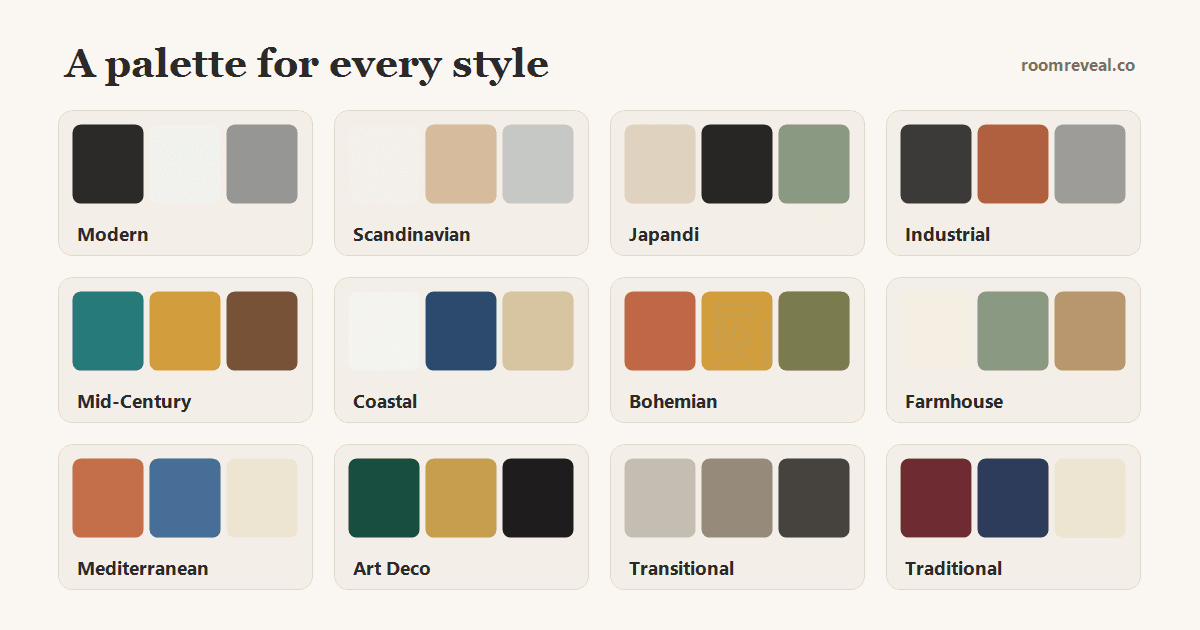
A cohesive home is one where you can walk from the entry to the kitchen to the bedroom and feel like every room belongs to the same house -- without any two rooms being copies of each other. It is the quality that makes a space feel considered and calm instead of like a series of unrelated decisions stacked under one roof. The common misconception is that cohesion means matching: same color everywhere, same furniture line, one style repeated room to room. It does not. The most interesting homes let each room have its own character while a few quiet threads tie the whole thing together. Here is how to build that flow, room by room, without flattening your house into a showroom.
Start With a Whole-Home Palette, Not a Room-by-Room One
The single biggest driver of cohesion is color. Most disjointed homes are disjointed because each room was decorated as its own project with its own unrelated palette. The fix is to choose a small house-wide palette first, then let each room draw from it in different proportions. A reliable structure is a shared neutral base (your walls, trim, and large upholstery), one or two recurring accent colors that appear in every room in some form, and then room-specific accents that change the mood without breaking the thread. Your living room might lean heavily on the warm neutral and use the accent sparingly; your bedroom might flip that ratio. Because the same colors recur, the rooms read as a family even though no two are identical. If you are starting from scratch, our guide to choosing a color scheme for your home walks through building that base.
Let One Color Thread Run Through Every Room
Beyond the base palette, pick one color and commit to seeing it somewhere in every space -- a "through-line." It does not have to be loud or large. It might be a deep green that shows up as a sofa in the living room, a stack of books in the office, a vase in the kitchen, and a throw in the bedroom. This single repeated note is doing quiet work: the eye registers it as it moves through the house and reads the spaces as connected. The trick is restraint -- one through-line color, used at different scales, is far more effective than trying to repeat your entire palette in every room.
Keep Hard Finishes Consistent
Soft furnishings can vary room to room; the permanent, expensive elements should not. The fastest way to break a home's flow is to switch flooring, trim color, and metal finishes from room to room with no logic. Aim for continuity in the things you rarely change:
- Flooring. Running the same flooring (or a closely related tone) through the main living spaces is the strongest unifier in any home -- it literally connects the rooms underfoot. Where you do change material, like tile in a bathroom, keep the undertone in the same family. See how to choose flooring for matching tones across spaces.
- Trim and doors. One trim color and one door style throughout reads as architecture; a different white in every room reads as accident.
- Metal finishes. Pick one or two metals and carry them through hardware, lighting, and fixtures house-wide. If you like to mix, do it deliberately and repeat the pairing -- our guide to mixing metals covers how.
Build a Shared Material Palette
Just as colors recur, materials should too. Decide on a small kit of materials -- say, light oak, brass, linen, and matte black -- and let those reappear across rooms in different combinations. The oak might be a dining table in one room and a nightstand in another; the linen shows up as curtains here and a duvet there. This is the same logic that makes a single room feel collected when you mix wood tones intentionally -- scaled up to the whole house. A consistent material palette means even rooms with different furniture and function share a texture and warmth, which is most of what "flow" actually is.
Repeat Shapes and a Level of Formality
Cohesion is not only color and material -- it is also line and tone. If your home leans toward soft, rounded forms (curved sofas, arched mirrors, oval tables), a single room full of hard, angular furniture will feel like it wandered in from a different house. Pick a general vocabulary -- mostly curved, mostly clean-lined, mostly traditional silhouettes -- and keep it loosely consistent. The same goes for formality: a polished, dressed-up living room flowing into a rough, casual dining room creates a jolt. Keep rooms within a step or two of each other on the formal-to-casual scale so the transitions feel intentional.
Treat Sightlines and Transitions as Their Own Rooms
In an open or semi-open floor plan, you rarely see one room in isolation -- you see two or three at once through a doorway or across a counter. Stand in each main spot and notice what is visible beyond it, then make sure those overlapping views share colors and tones. The accent chair you can see from the kitchen should relate to the kitchen, even if it lives in the living room. Hallways, entries, and stair landings are the connective tissue between rooms and are the most commonly neglected -- a hallway painted and styled to bridge the rooms on either side does more for flow than any single room. For open layouts specifically, our guide to decorating an open floor plan goes deeper on zoning without walls.
Cohesion Is Not Uniformity
The goal is a through-line, not a theme park. Once the threads are in place -- shared palette, consistent finishes, a common material kit, a loosely repeated vocabulary -- each room is free to have its own personality. A bolder bedroom, a calmer office, a more playful nursery all coexist happily as long as they pull from the same underlying kit. If anything, contrast between rooms makes a cohesive home feel richer, because the connections do the unifying and the differences supply the interest. Rooms that match exactly feel like a hotel; rooms that share a language feel like a home.
Common Mistakes That Break the Flow
- Decorating one room at a time with no master plan. Each room ends up internally fine but unrelated to the next. Set the house-wide palette and material kit first.
- Switching flooring and trim room to room. Inconsistent permanent finishes are the loudest signal of a disjointed home. Keep the hard stuff continuous.
- A different white everywhere. Five whites across trim, walls, and ceilings read as mismatched. Standardize them.
- Mismatched metals with no repetition. One metal in the kitchen, another in the bath, a third in lighting, none repeated. Choose one or two and carry them through.
- Ignoring the in-between spaces. Beautifully styled rooms connected by a blank, unconsidered hallway still feel broken. Style the transitions.
- Confusing cohesive with matchy. Buying a full matching furniture set per room is the lazy version and usually feels flat. Threads, not clones.
See the Whole House Come Together First
The hardest part of a cohesive home is holding the whole thing in your head at once -- imagining how a palette and a material kit will carry from one room into the next before you commit to paint, flooring, or furniture. Upload photos of your rooms and try a consistent palette, finish, and style across them with Room Reveal to see how the spaces relate before you buy anything. To go deeper on the pieces that build flow, see our guides to choosing a whole-home color scheme and mixing decorating styles, and browse cohesive, palette-driven looks like transitional living room ideas and Scandinavian living room ideas for inspiration.
Ready to transform your room?
Upload a photo and see it redesigned in any of our 12 styles.
Try Room RevealLooking for inspiration? Browse style-by-room ideas with tips, palettes, and looks to try in your own space.
Explore room ideas