How to Choose a Color Scheme for Your Home: A Room-by-Room Guide
How to choose a color scheme for your home: use the 60-30-10 rule, the color wheel, undertones, and your room's light to build a palette that flows beautifully from room to room.
Room Reveal Team
June 26, 2026
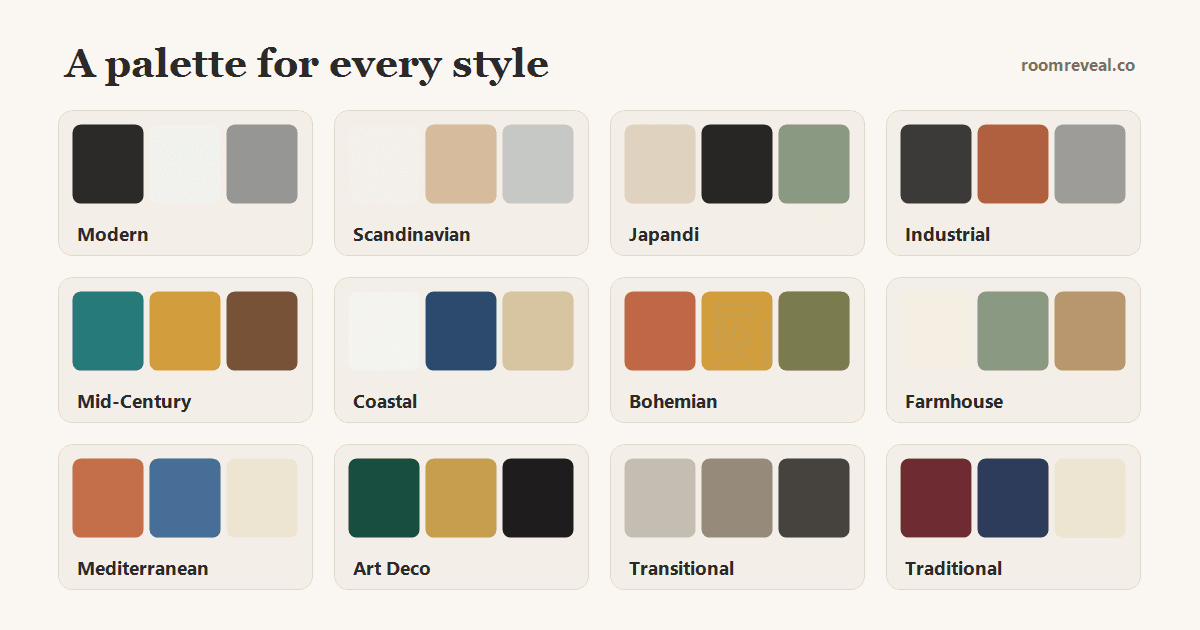
Color is the single biggest decision you make in a room. It sets the mood before anyone notices the furniture, it makes a space feel larger or cozier, and it ties everything together -- or makes it feel like a jumble. Yet choosing a color scheme is where most people freeze. There are thousands of paint chips, every room has different light, and a color that looks perfect on a tiny sample can overwhelm four walls. This guide gives you a repeatable method: how to find a starting point, build a balanced palette with the 60-30-10 rule, use the color wheel to combine hues, read undertones, account for light, and make your colors flow from one room to the next.
Start With a Fixed Element, Not a Paint Chip
The easiest way to build a scheme is to borrow it from something you already love and can't easily change. A patterned rug, a piece of art, a sofa, a tile, a wood floor, or even a view out the window already contains a curated set of colors that work together. Pull three or four hues from that anchor and let them drive the room. Designers call this "drawing the palette from the busiest pattern," and it works because someone already did the hard color-balancing for you. Starting from a fixed element also keeps you grounded -- you're choosing wall colors to flatter what's staying, instead of painting first and then struggling to furnish around an arbitrary color.
The 60-30-10 Rule: Balance in Three Numbers
A palette needs proportion, not just pretty colors. The classic decorator's formula is 60-30-10:
- 60% a dominant color -- usually the walls, large rugs, and big upholstery. This is your quiet backdrop, most often a neutral or a soft, low-saturation hue.
- 30% a secondary color -- think accent furniture, curtains, bedding, or an area rug. It should contrast enough with the dominant color to be interesting.
- 10% an accent color -- the punch: pillows, art, a vase, a lamp, a throw. This is where you can be bold, because it's a small dose and easy to swap later.
The ratio matters more than the exact colors. Keep the proportions and almost any combination starts to feel intentional and calm rather than chaotic. When a room feels "off," it's often because two strong colors are fighting at 50-50 instead of settling into a clear hierarchy.
Use the Color Wheel to Combine Hues
Once you know your proportions, the color wheel tells you which hues play well together. A few reliable schemes:
- Monochromatic -- one color in several shades and tints (pale blue, mid blue, navy). Serene and sophisticated, very hard to get wrong.
- Analogous -- colors next to each other on the wheel (blue, blue-green, green). Harmonious and easy on the eye; great for restful rooms.
- Complementary -- opposites on the wheel (blue and orange, green and terracotta). High energy and contrast; use one as the dominant and the other strictly as the 10% accent so it doesn't overwhelm.
- Triadic -- three evenly spaced colors. Playful and balanced, ideal for kids' rooms and creative spaces when kept slightly muted.
You don't have to memorize color theory. Pick the relationship that matches the mood you want -- calm leans monochromatic or analogous; lively leans complementary or triadic -- and let the 60-30-10 ratio keep it balanced.
Read the Undertones
The reason a "perfect" gray turns out lilac or the "warm white" reads yellow is undertones -- the subtle secondary hue hiding inside a color. Every neutral has one: grays can lean blue, green, or purple; whites can lean yellow, pink, or blue; beiges can lean pink or gold. Two colors clash when their undertones fight, even if their main color looks the same. Before committing, hold samples against each other and against your fixed elements, and ask whether the undertones agree. Cool undertones (blue, green, gray) feel crisp and modern; warm undertones (yellow, red, brown) feel cozy and inviting. Picking a consistent temperature across a room is half the battle.
Test Colors in Your Own Light
Light changes color dramatically, so never trust a chip in the store. North-facing rooms get cool, flat light that mutes warm colors and can make grays feel cold -- lean a touch warmer to compensate. South-facing rooms get bright, warm light all day and can take cooler, deeper colors. East light is warm in the morning and cool by afternoon; west light is the reverse. Artificial bulbs matter too: warm bulbs amplify yellows and reds, cool bulbs amplify blues. Always test your top choices large (a poster-sized swatch or a sample wall) and look at them at morning, midday, and night before you buy a single can. If repainting to test feels like too much, previewing the color digitally first saves you the trial-and-error -- more on that below.
Make It Flow From Room to Room
A home feels cohesive when its rooms share a thread, not when every room is identical. The simplest approach is a whole-home palette: choose five or six colors -- a couple of neutrals plus a few accents -- and let each room draw from that same family in different proportions. Your living room might be 60% warm white with sage accents; the adjacent hallway uses the same white as its dominant; the bedroom flips sage to dominant. Carry one consistent trim and ceiling color throughout to act as the connective tissue. Pay special attention to sightlines -- colors you can see from one room into the next should agree. This is how designers make an open-plan home feel calm instead of busy: variety within a disciplined, repeating palette.
Common Color Mistakes to Avoid
- Choosing wall color first. Paint comes in every shade; furniture and rugs don't. Pick the hard-to-find pieces first and match paint to them.
- Ignoring undertones. The most common cause of a scheme that "almost works." Always compare samples side by side.
- Too many dominant colors. More than one or two strong colors with no clear hierarchy reads as chaos. Respect the 60-30-10 ratio.
- Forgetting the whole-home view. Rooms that look great alone can clash through a doorway. Plan adjoining spaces together.
- Skipping the large test. A two-inch chip and a four-wall room are different experiences. Always test big, in your own light.
See Your Palette Before You Commit
The fastest way to settle a color decision is to see it on your actual room. Upload a photo of your space and preview different palettes and styles with Room Reveal -- it lets you compare warm versus cool, bold versus neutral, and whole looks side by side before you buy paint or furniture, so you skip the expensive trial and error. For palette inspiration by style, browse our modern living room ideas and scandinavian living room ideas, each with a ready-made color story. And once you've narrowed your colors, see our guide on how to visualize paint colors before you paint to lock in the exact shade.
Ready to transform your room?
Upload a photo and see it redesigned in any of our 12 styles.
Try Room RevealLooking for inspiration? Browse style-by-room ideas with tips, palettes, and looks to try in your own space.
Explore room ideas