How to Mix Decorating Styles Without It Looking Like a Mess
How to mix decorating styles that actually work together: use a unifying thread, the 80/20 rule, repeated materials and color, and balanced scale to pull off an eclectic look on purpose.
Room Reveal Team
June 26, 2026
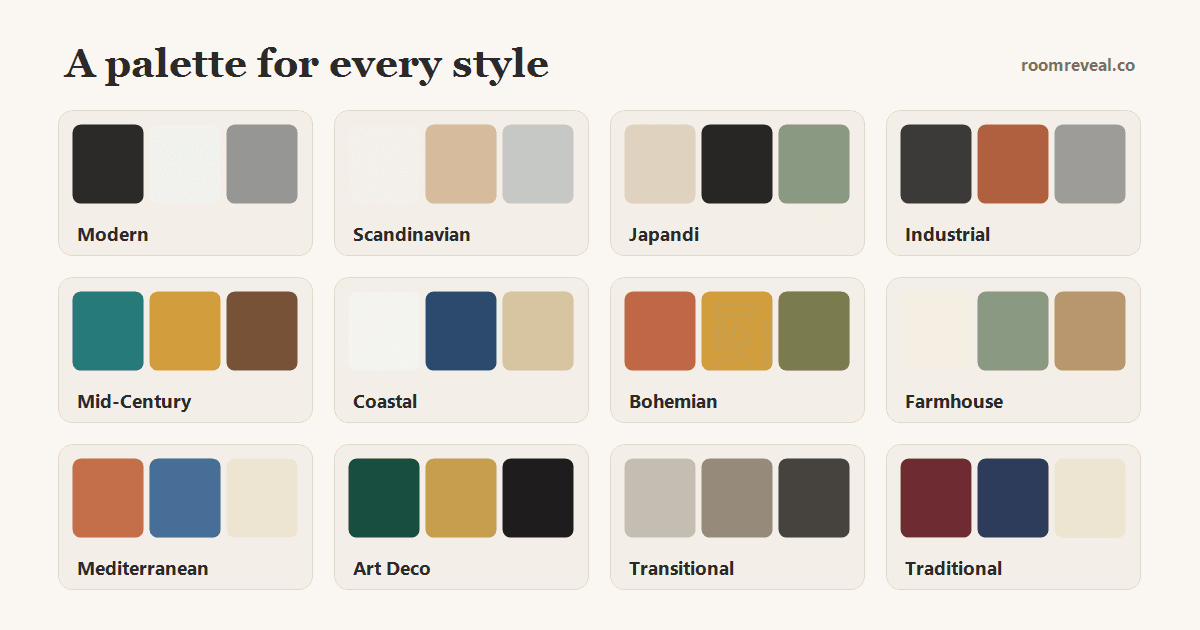
Almost no real home is decorated in one pure style. You inherit a traditional dining set, fall for a mid-century chair, already own a sectional that's basically modern, and pick up a few bohemian textiles on the way. The fear is that combining them reads as chaos -- a room that can't decide what it is. But the most interesting, personal rooms are almost always a deliberate mix of two or three styles, not a showroom built from a single catalog. The difference between "eclectic" and "cluttered" isn't restraint for its own sake; it's a few rules that give a mixed room a sense of intention. This guide covers how to combine styles on purpose so the result looks collected, layered, and unmistakably yours.
Pick a Dominant Style, Then a Supporting One
The fastest way to keep a mix from turning into noise is to decide which style is in charge. Choose one as the foundation -- roughly 80% of the room -- and let a second (and maybe a small third) play a supporting role. The dominant style sets the larger pieces, the wall treatment, and the overall mood; the secondary style shows up in accents, a statement chair, lighting, or textiles. A predominantly Scandinavian room with a few industrial metal accents reads as confident and curated. The same two styles at a 50/50 split read as indecision. Naming your lead style first gives every later decision an easy test: does this support the foundation, or fight it?
Find a Unifying Thread
Mixed rooms hold together when something repeats across the different pieces. That common thread is what tells the eye "these belong together" even when the shapes and eras differ. The most reliable threads are:
- A shared color palette. If a traditional sofa, a modern lamp, and a boho rug all live within the same three or four colors, the styles stop competing. Color is the strongest unifier of all.
- A repeated material or finish. Carry one wood tone, one metal (all brass, or all black iron -- not both), or one texture through several pieces to stitch the room together.
- A consistent mood. Light and airy, or moody and saturated -- pick one temperature and keep every style choice loyal to it.
You only need one strong thread, but two or three woven together make a mix feel genuinely designed rather than accidental.
Balance Scale and Visual Weight
Style is only half the equation; scale is the other half. A delicate antique side table next to a chunky modern sofa can work beautifully -- or look like a mistake -- depending on whether the room balances heavy and light pieces overall. Distribute visual weight around the space instead of stacking all the big, dark, ornate things on one side. Vary heights so the eye travels: a tall bookcase, a low credenza, a mid-height chair. When an eclectic room feels "off" despite a good palette, the culprit is usually scale, not style -- two pieces fighting for the same visual job, or all the weight pooling in one corner.
Repeat Each Style at Least Twice
A single piece that matches nothing else in the room reads as a stray -- like it wandered in by accident. The fix is the "rule of two": echo each style at least twice so it looks like a deliberate choice. One ornate gilded mirror feels random; the same mirror plus a turned-leg console or a classic table lamp establishes a clear traditional thread inside an otherwise modern room. Repetition is what converts "a weird one-off" into "a layer." It doesn't mean matchy -- two nods to a style, placed apart, are enough to make the eye register it as intentional.
Mix Eras and Old With New
Some of the best contrast comes from time, not just style. Pairing old and new -- a vintage rug under a sleek modern table, an antique dresser beside a contemporary bed -- gives a room depth and a story that an all-new space can't fake. New pieces keep the room from feeling like a museum; old or handmade pieces keep it from feeling like a furniture showroom. Aim for at least one piece with some age or patina in every room. If buying vintage isn't an option, natural materials that wear in (leather, solid wood, woven fiber, stone) add the same sense of lived-in character.
Let the Room Breathe
When you're combining several looks, negative space becomes essential. Empty wall, bare floor, and clear surfaces give the eye somewhere to rest between the different elements -- and rest is what separates "layered" from "cluttered." Resist the urge to fill every corner just because you have pieces from multiple styles you love. Edit ruthlessly: a mixed room with a little breathing room always reads as more sophisticated than a crowded one, no matter how good the individual pieces are. If a space feels busy, the answer is usually to remove something, not to add a unifying accessory.
Common Style-Mixing Mistakes
- No clear lead. Two styles at 50/50 read as indecision. Pick a dominant style and commit.
- No unifying thread. Without a shared color, material, or mood, the pieces never cohere.
- One-off orphans. A style represented by a single item looks like a mistake -- echo it at least twice.
- Clashing metals and woods. Three competing wood tones and mixed metals fragment a room; limit and repeat them.
- Ignoring scale. A good palette can't rescue pieces that are wildly mismatched in weight or all crowded on one side.
- Over-filling. Mixing styles is not a license to keep everything. Negative space is part of the design.
Test Your Mix Before You Commit
The hardest part of mixing styles is that you can't always tell whether a combination works until the pieces are in the room together -- and by then they're bought and carried up the stairs. Previewing removes that risk. Upload a photo of your space and try blending styles with Room Reveal -- see how a modern room takes a few traditional or bohemian accents, or how swapping the dominant style changes the whole feel, before you spend a cent. To get clear on each style's signatures before you blend them, read our guide on how to choose an interior design style, and for inspiration on individual looks worth combining, browse our transitional living room ideas (transitional is itself a polished blend of traditional and modern) and mid-century living room ideas. Once your mix is set, our guide on choosing a color scheme helps you lock in the unifying thread.
Ready to transform your room?
Upload a photo and see it redesigned in any of our 12 styles.
Try Room RevealLooking for inspiration? Browse style-by-room ideas with tips, palettes, and looks to try in your own space.
Explore room ideas