How to Choose an Interior Design Style (A Simple Decision Framework)
Paralyzed by Pinterest? This is a calm, step-by-step framework for finding the design style that actually fits your home, your life, and your budget -- not just the one that's trending.
Room Reveal Team
June 23, 2026
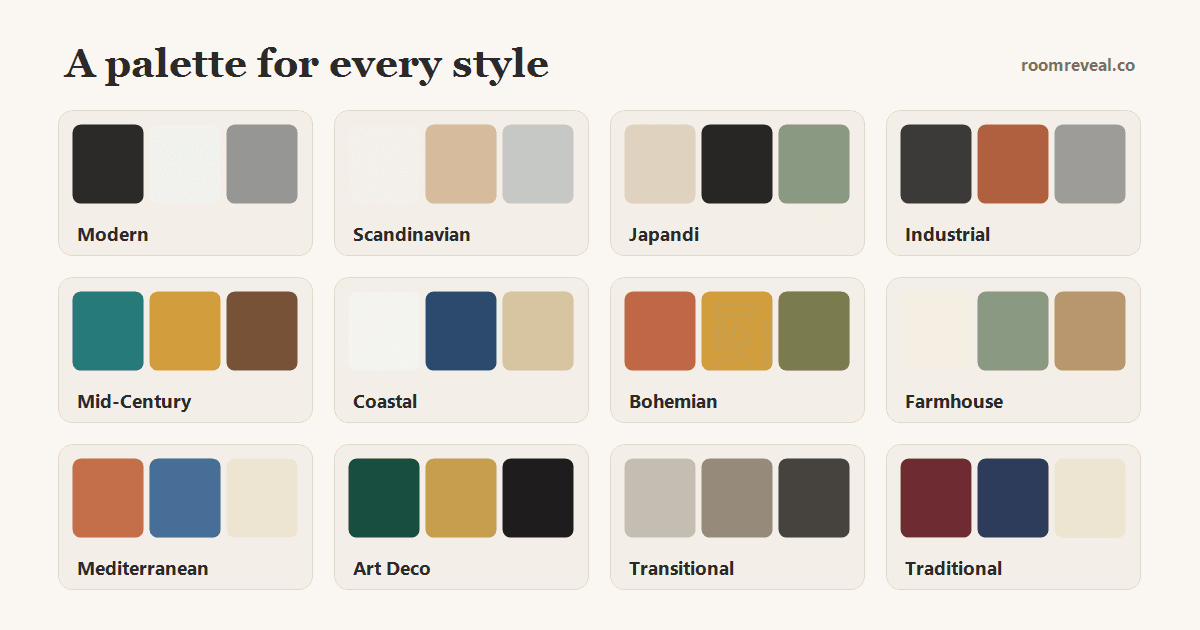
Most people don't struggle to find design styles they like. They struggle because they like too many. One day it's serene Japandi, the next it's a moody industrial loft, and somewhere in the chaos of saved photos the actual decision never gets made. The result is a home that feels like a collage of half-committed ideas rather than a place with a point of view.
Choosing a style isn't about finding the "best" one -- there isn't one. It's about finding the style that fits the room you actually have, the life you actually live, and the budget you actually want to spend. This guide gives you a repeatable framework to get there, so you can stop scrolling and start committing.
Why "Just Pick What You Like" Doesn't Work
The advice to "go with your gut" fails most people for a simple reason: taste in images and taste in living spaces are different things. A dramatic, color-saturated room can be thrilling in a photo and exhausting to live in. A stark minimalist space can look like a museum online and feel cold and unwelcoming at 7am on a Tuesday.
A good framework doesn't override your taste -- it filters it through reality. It asks what your space can support, what your life demands, and what you'll still love in five years. What survives all three is your style.
Step 1: Audit What You Already Have
Before you chase any aesthetic, look hard at your room's fixed bones -- the things you won't be changing soon. These quietly rule certain styles in and others out.
- Architecture and era. A 1920s home with crown molding and arched doorways leans naturally toward traditional, art deco, or Mediterranean. A new-build box with clean drywall takes happily to modern, Scandinavian, or japandi.
- Light. North-facing or dim rooms come alive with warm, light palettes (coastal, Scandinavian) and can feel oppressive in dark, heavy schemes. Bright, sunny rooms can carry deeper, moodier looks.
- Fixed finishes. Floor color, countertop material, tile, and built-ins are expensive to change. A style that fights your warm oak floors or your gray tile will cost you to force.
- Room size and ceiling height. Small or low rooms reward light, airy styles; grand rooms can absorb the weight of traditional or art deco.
Write down the constraints you won't change. They've just narrowed your field for free.
Step 2: Define How the Room Needs to Work
Style is downstream of function. A look that ignores how you live becomes a chore to maintain and a source of quiet resentment.
- Who uses the room? Kids and pets make pale upholstery and fragile finishes a daily battle. A household that entertains needs flexible, durable seating more than a perfect silhouette.
- How much upkeep do you want? Minimalist and japandi rooms look effortless but demand constant tidiness -- there's nowhere to hide clutter. Layered styles like bohemian or traditional are far more forgiving of real life.
- What does the room actually do? A living room that doubles as a home office, a playroom, and a guest space needs storage and zoning that some highly curated styles resist.
Be honest here rather than aspirational. The goal is a home that works on your messiest day, not just your tidiest.
Step 3: Find the Through-Line in What You're Drawn To
Now bring in inspiration -- but analyze it instead of just collecting it. Pull together 15 to 20 rooms you genuinely love, then look for the pattern beneath them.
- Color temperature. Are you saving warm, earthy rooms or cool, crisp ones? This single axis separates a huge number of styles.
- Visual density. Do your favorites feel spare and uncluttered, or rich and layered? Be honest about which one you find restful.
- Materials and lines. Notice the repeats -- natural wood and linen, or metal and glass; soft curves, or hard geometry.
- The outliers. Set aside the one or two images that don't fit the pattern. Those are crushes, not commitments. The pattern is your style; the outliers are accents you can borrow sparingly.
Most people discover their saved rooms cluster around two adjacent styles -- say, Scandinavian and japandi, or transitional and modern. That overlap is good news: it points to a coherent direction with room to flex.
Step 4: Pressure-Test Against Budget and Permanence
Every style has a cost profile, and matching it to your budget prevents the most common failure -- a half-finished version of an expensive look that reads as "almost" rather than "intentional."
- Budget-friendly to fake well: Scandinavian, modern, and coastal lean on light paint, simple lines, and affordable natural textures.
- Expensive to do convincingly: art deco (rich materials, statement pieces), traditional (quality wood, layered textiles), and true industrial (architectural features) punish a thin budget.
- Forgiving and incremental: bohemian and farmhouse can be built slowly from thrifted and collected pieces without looking unfinished along the way.
Separate the permanent from the swappable, too. Big-ticket, hard-to-change items -- sofa, flooring, cabinetry -- should sit in a neutral, broadly compatible lane. Save the bold, era-specific choices for the things you can change cheaply: paint, textiles, art, and accessories. That one rule lets your style evolve without expensive regret.
Step 5: See It in Your Actual Room Before You Commit
Here's the gap the whole process keeps running into: a style can pass every test on paper and still feel wrong once it's in your room, with your light, your proportions, and your fixed finishes. Imagination is a poor renderer. This is exactly where digital visualization earns its place.
Instead of buying a single thing, you can take a photo of the room you actually have and see a credible, photo-realistic version of it in each style you're weighing -- the same sofa wall as Scandinavian, then japandi, then warm modern -- and react to real images rather than abstract mood boards. You'll often eliminate a contender instantly ("that's too cold in here") and fall for one you'd underrated. Treat it as a decision and planning tool that de-risks the choice, not a replacement for the judgment you bring to it. When two finalists remain, seeing both in your own space is usually all it takes to break the tie.
A Quick Recap Checklist
- List the fixed features you won't change -- and let them rule styles out
- Define how the room must function and how much upkeep you'll tolerate
- Gather 15-20 rooms you love and find the through-line
- Set the outliers aside as accents, not foundations
- Match the style's cost profile to your real budget
- Keep permanent pieces neutral; put boldness in the swappable layers
- Visualize your top one or two styles in your actual room before you buy
Work through those steps and "what's my style?" stops being an anxious, endless scroll and becomes a clear, confident decision. The right style isn't the most beautiful one in someone else's home -- it's the one that fits yours and still feels like you a year from now.
Ready to see your top styles side by side in your own space? Try Room Reveal to visualize your room in any style in seconds and choose with confidence.
Ready to transform your room?
Upload a photo and see it redesigned in any of our 12 styles.
Try Room RevealLooking for inspiration? Browse style-by-room ideas with tips, palettes, and looks to try in your own space.
Explore room ideas