Modern Style Explained: Origins, Hallmarks, and How to Get the Look
What is modern interior design? A complete guide to its origins, the hallmarks that define it, a working palette, how it differs from contemporary, and how to get the clean look.
Room Reveal Team
June 25, 2026
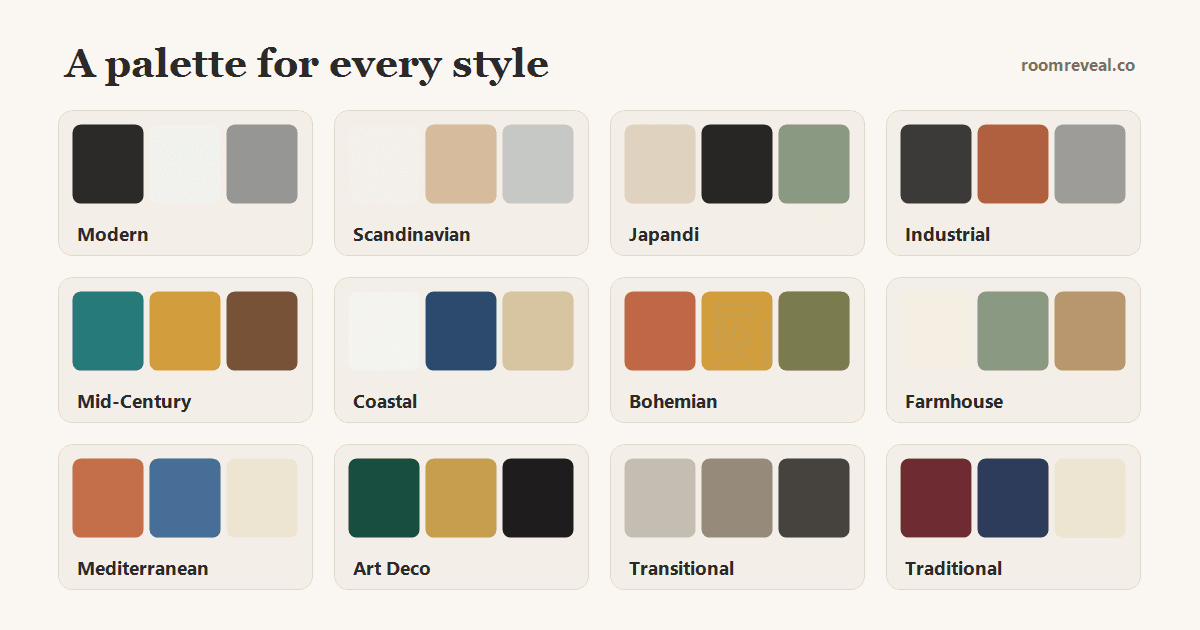
Modern is the style people reach for when they say they want a room to feel "clean" and "uncluttered" -- and it's also the style most often confused with everything else. Half the rooms tagged "modern" online are really contemporary, mid-century, or minimalist. True modern design is a specific, century-old movement with its own logic: form follows function, ornament is stripped away, and what's left is honest materials, clean geometry, and calm, open space. This guide explains where modern style came from, the hallmarks that actually define it, the palette and materials that make it work, how it differs from "contemporary," and how to get the look in a room you already have.
What Is Modern Interior Design?
Modern design grew out of the early-to-mid-20th-century modernist movement -- the Bauhaus school in Germany, Scandinavian functionalism, and the architects and designers who rejected the heavy, fussy, ornamented interiors of the Victorian era. Their guiding idea, borrowed from architect Louis Sullivan, was that "form follows function": every element should earn its place by doing a job, and decoration for its own sake was the enemy. The result was a look built on clean lines, open space, and honest materials shown for what they are.
That historical root is what separates modern from its look-alikes. "Modern" is not a synonym for "current" -- it refers to that specific design era and its principles. So a modern room isn't just whatever's trendy now; it's a deliberate, edited space where structure, function, and restraint do the decorating. Where bohemian layers up and traditional ornaments, modern strips down until only the essential, well-made elements remain.
The Hallmarks That Define Modern Style
1. Clean lines and simple geometry
Modern furniture and architecture favor crisp, straight lines and clean geometric forms -- low-profile sofas, flat planes, right angles softened by the occasional smooth curve. Silhouettes are simple and deliberate, with nothing fussy, carved, or overly ornamented. The shapes themselves do the visual work.
2. Function over ornament
Every piece earns its place. Modern interiors are uncluttered and purposeful: storage is built-in and hidden, surfaces are kept clear, and decorative objects are few and chosen with care. The beauty comes from proportion, material, and restraint rather than from added embellishment.
3. Honest, natural materials
Modern design shows materials for what they are -- natural wood with visible grain, polished metal, glass, leather, stone, and concrete. Finishes are smooth and unfussy, and there's a deliberate contrast between warm woods and cool metal or glass. Nothing pretends to be something it isn't.
4. A neutral base with open, airy space
The palette is grounded in neutrals -- white, black, gray, taupe, and warm wood tones -- which keeps rooms calm and lets the architecture breathe. Equally important is the negative space: modern rooms leave room around furniture and surfaces empty on purpose, so the eye can rest and the geometry reads clearly.
5. Bold but sparing accents
Against the neutral backdrop, modern style allows a few confident pops -- a single saturated accent color, a large piece of graphic art, or one sculptural light fixture. The key is restraint: one or two strong moments rather than many competing ones, so each accent lands.
The Modern Palette
Modern leans on a disciplined neutral foundation: crisp white, soft and charcoal grays, taupe, and black for graphic contrast, all warmed by natural wood tones -- walnut, oak, teak. That restrained base is what gives the style its calm, gallery-like clarity. Color enters as a deliberate accent rather than a theme: a single bold hue -- a deep mustard, rust, navy, forest green, or a clear primary -- carried through art, a rug, or one statement chair. Metals tend toward polished chrome, stainless, or matte black rather than ornate gold. The goal is a clean, cohesive backdrop where one or two intentional colors do all the talking, so resist the urge to introduce a third and fourth competing accent.
How to Get the Look in Any Room
- Edit ruthlessly first. Modern starts with subtraction -- clear surfaces, remove visual noise, and keep only pieces that serve a purpose or that you genuinely love. The empty space is part of the design.
- Choose clean-lined, low-profile furniture. Favor simple geometric silhouettes with exposed legs and unadorned frames; let the shapes stay crisp rather than overstuffed or carved.
- Build on a neutral base. Anchor the room in white, gray, taupe, and warm wood, then add a single confident accent color so the palette stays calm and cohesive.
- Mix warm and cool materials. Pair natural wood with metal, glass, or stone for contrast; honest materials shown plainly are the heart of the look.
- Make one element sculptural. A single statement light fixture, an oversized piece of graphic art, or one architectural chair gives a clean room a focal point without clutter.
- Hide the clutter. Use built-in or closed storage so everyday items stay out of sight and surfaces read clean and intentional.
- Keep accessories few and large. A handful of bigger, well-chosen objects reads as modern; many small trinkets read as busy.
Modern vs. Contemporary: What's the Difference?
The two terms get used interchangeably, but they aren't the same. Modern refers to a specific, fixed design era and its principles -- the clean-lined, function-first look described above -- and it doesn't change. Contemporary simply means "of the moment," so it shifts as trends shift and borrows freely from many styles at once. A modern room will look essentially the same in ten years; a contemporary room reflects whatever is current now. In practice the two overlap heavily and many rooms blend them, but if you want the timeless version, anchor to modern's principles rather than chasing the trend cycle.
Common Modern Style Mistakes
The most common misstep is mistaking modern for cold and bare -- stripping a room down until it feels like an empty showroom with no warmth. The fix is to layer in natural wood, soft textiles, and a little texture so the clean lines still feel livable. The second mistake is breaking the discipline of the palette by adding too many accent colors; modern depends on a neutral base with one or two intentional pops, and a fourth and fifth color quietly turns clarity into clutter. The third is confusing modern with merely trendy and filling the room with of-the-moment pieces that will date fast -- anchor instead to the timeless principles of clean form, honest materials, and edited space, and the room stays modern for years.
See It in Your Own Room
The fastest way to understand modern style is to see it applied to a space you already know. Upload a photo of your room and preview it restyled with Room Reveal -- experiment with clean-lined furniture, a calm neutral base, and a single bold accent until the space feels edited rather than empty. For room-specific inspiration, browse our modern living room ideas and modern bedroom ideas, or see how the look adapts to a workspace with modern home office ideas. And if you're still deciding between looks, our guide to 12 interior design styles puts modern design in context alongside its neighbors.
Ready to transform your room?
Upload a photo and see it redesigned in any of our 12 styles.
Try Room RevealLooking for inspiration? Browse style-by-room ideas with tips, palettes, and looks to try in your own space.
Explore room ideas