Mid-Century Modern Style Explained: Origins, Hallmarks, and How to Get the Look
What is mid-century modern style? A complete guide to its 1950s origins, the hallmarks that define it, a working palette, and how to get the look in any room.
Room Reveal Team
June 25, 2026
"Mid-century modern" is one of those phrases nearly everyone recognizes on sight and few can define on the spot. You know it instantly -- the tapered wooden legs, the low sculptural sofa, the warm walls and the single bold accent chair -- but the style is far more than a collection of famous furniture. This guide breaks down where mid-century modern came from, the hallmarks that actually define it, the palette and materials that make it work, and a practical way to get the look in any room without it sliding into either a soulless showroom or a thrift-store costume.
What Is Mid-Century Modern?
Mid-century modern is a design movement that ran roughly from the mid-1940s through the late 1960s, born of postwar optimism, new manufacturing materials, and a belief that good design should be affordable and made for everyday life. It grew out of the earlier Bauhaus and International Style schools and was shaped on both sides of the Atlantic -- in the United States and in Scandinavia -- where designers paired clean industrial forms with the warmth of natural wood.
The core idea is function expressed honestly and beautifully. Forms are simple and uncluttered, applied ornament is stripped away, and the structure of a piece -- the legs, the joinery, the silhouette -- becomes the decoration. What keeps it from feeling cold is its embrace of organic shapes and natural materials: a chair can be minimal and still curve like something grown rather than built. That tension between clean lines and organic warmth is the whole signature of the style, and the reason it still reads as fresh sixty years later.
The Hallmarks That Define Mid-Century Modern
1. Clean lines and organic curves, together
The look balances two impulses at once: crisp geometric lines on case goods and tables, and soft, sculptural curves on seating and lighting. A boxy walnut credenza shares a room with a gently scooped lounge chair, and the contrast is the point. If a room feels rigidly rectangular, it's missing the organic half; if it's all curves, it's missing the discipline.
2. Tapered legs and furniture that floats
The single most recognizable signature is the leg: slim, tapered, often splayed at a slight angle, lifting furniture up off the floor. Raised pieces let light and floor show beneath them, which makes a room read as airy and larger than it is. Sofas, sideboards, beds, and chairs all sit on visible legs rather than sitting heavy on the ground.
3. Warm woods, especially teak and walnut
Wood is the soul of the style -- rich, mid-to-dark tones with visible grain, most classically teak and walnut, but also oak and rosewood. The finish is satin or oiled rather than high-gloss, so the grain stays honest. Wood appears everywhere: furniture frames, paneling, legs, and sculptural accents, giving even a spare room genuine warmth.
4. Function over fuss
Every piece is designed to do its job without apology or excess. Storage is built to be used, seating is built to be sat in, and nothing is decorated just to be decorated. This functional honesty is why so many original designs still feel modern -- they were never chasing a trend, only solving a problem cleanly.
5. A bold accent against a neutral base
Mid-century rooms are mostly calm and neutral, then punctuated by one or two saturated, confident colors -- a mustard armchair, a burnt-orange cushion, an olive lamp. The restraint is what makes the pop work. One brave accent in an otherwise quiet room is far more "mid-century" than a rainbow of competing brights.
The Mid-Century Modern Palette
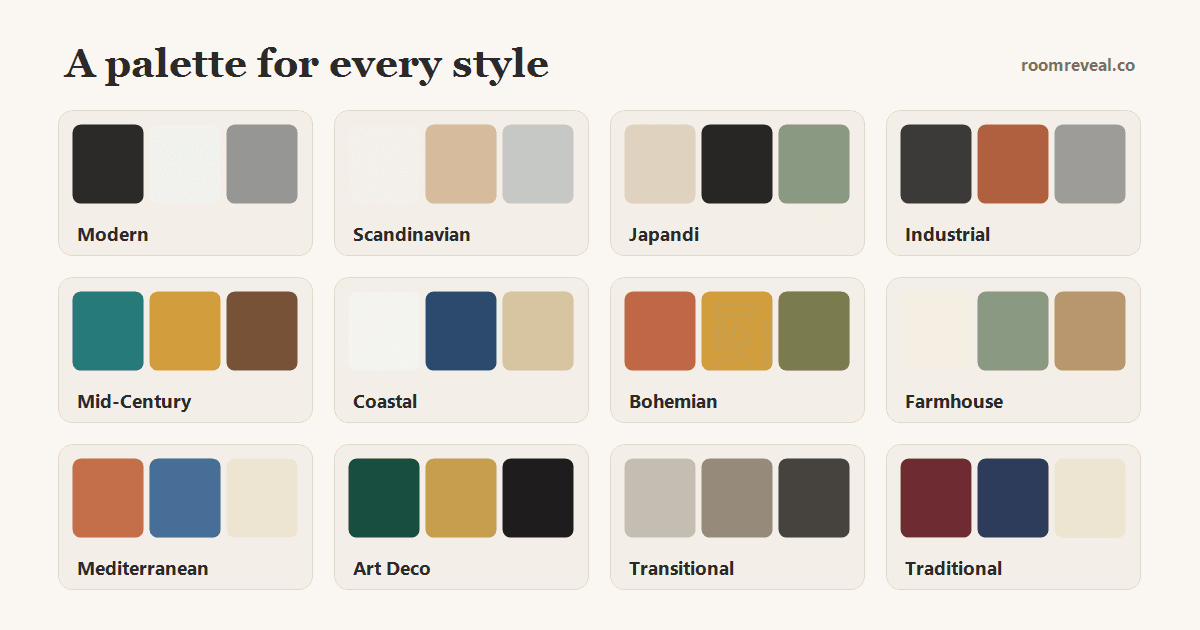
The foundation is warm and grounded: soft white, warm beige, and greige on the walls, with the browns of teak and walnut doing much of the heavy lifting. Against that base sit the era's signature accent colors -- mustard yellow, burnt orange, avocado and olive green, teal, and rust -- used sparingly and confidently. Black is welcome as a graphic anchor in legs, frames, and lighting. The rule of thumb: keep the bulk of the room warm and neutral, let wood tones provide the depth, and reserve the saturated retro hues for a few deliberate accents. Avoid cool, sterile grays and an all-white scheme -- both drain away the warmth that separates mid-century modern from plain minimalism.
How to Get the Look in Any Room
- Choose furniture with legs. Pick pieces raised on slim, tapered legs so the room feels light and the floor stays visible -- it's the fastest way to signal the style.
- Lead with a warm wood. Anchor the room with one solid teak, walnut, or oak piece -- a credenza, sideboard, or dining table -- and let its grain set the tone.
- Mix straight lines with one sculptural curve. Pair a clean-lined sofa or shelf with a curvy lounge chair or a rounded pendant so the room has both crispness and softness.
- Add exactly one or two bold accents. A mustard chair or a burnt-orange throw against a neutral base does more than a dozen colorful pieces fighting for attention.
- Keep surfaces edited. Mid-century rooms are uncluttered; a few well-chosen objects -- a ceramic vase, a stack of books, a single piece of graphic art -- beat a crowded shelf.
- Use a statement light. A sputnik chandelier, a globe pendant, or an arc floor lamp is practically a mid-century shorthand and instantly dates the room to the era.
- Choose geometric or abstract patterns in textiles -- atomic motifs, simple repeats, and bold graphic shapes -- rather than fussy florals or heavy traditional prints.
Common Mid-Century Modern Mistakes
The most common misstep is over-theming the room into a period set -- when every object screams "1958," the space stops feeling like a home and starts feeling like a museum diorama. The fix is to treat mid-century as the framework and let a few contemporary pieces breathe through it. The second mistake is overloading the color: the style relies on a neutral base with restrained accents, so three or four competing brights quickly tip into kitsch. And the third is forgetting the "modern" half -- chasing distressed, novelty retro props instead of the clean proportions and honest materials that made the originals timeless. Mid-century modern is about disciplined simplicity with warmth, not nostalgia for its own sake.
See It in Your Own Room
The fastest way to understand mid-century modern is to see it applied to a space you already know. Upload a photo of your room and preview it restyled with Room Reveal -- experiment with warm woods, tapered-leg furniture, and a single bold accent until the balance feels right. For room-specific inspiration, browse our mid-century modern living room ideas and mid-century modern bedroom ideas, or see how the style adapts to a workspace with mid-century modern home office ideas. And if you're still deciding between looks, our guide to 12 interior design styles puts mid-century modern in context alongside its neighbors.
Ready to transform your room?
Upload a photo and see it redesigned in any of our 12 styles.
Try Room RevealLooking for inspiration? Browse style-by-room ideas with tips, palettes, and looks to try in your own space.
Explore room ideas