Japandi Style Explained: Origins, Hallmarks, and How to Get the Look
What is Japandi style? A complete guide to the Japanese-Scandinavian hybrid -- its origins, the hallmarks that define it, a working palette, and how to get the look in any room.
Room Reveal Team
June 25, 2026
Japandi is one of the most-searched interior styles of the decade, and yet it's one of the easiest to get subtly wrong. It looks simple -- a few well-chosen pieces, a calm palette, a lot of breathing room -- but that simplicity is doing real work. This guide breaks down where Japandi comes from, the hallmarks that actually define it, the palette and materials that make it sing, and a practical way to get the look in any room without it tipping into either cold minimalism or generic "beige modern."
What Is Japandi?
Japandi is a hybrid of two design philosophies that turn out to share a spine: Japanese minimalism and Scandinavian functionalism. From Japan it borrows wabi-sabi -- the appreciation of imperfection, natural materials, and quiet restraint -- along with low-slung furniture and a deep respect for craft. From Scandinavia it takes hygge and lagom -- coziness, warmth, "just enough" -- plus pale woods, soft textiles, and light-filled rooms.
The reason the two blend so naturally is that they're solving the same problem from opposite directions. Scandinavian design warms up minimalism with soft texture and light wood; Japanese design disciplines coziness with negative space and intention. Put them together and you get a room that feels serene and inviting -- minimal without feeling austere, warm without feeling cluttered. That balance is the whole point of Japandi.
The Hallmarks That Define Japandi
1. Negative space is a feature, not a gap
In Japandi, empty space is treated as deliberate -- room to breathe, a pause between objects. Surfaces stay mostly clear, walls aren't crowded, and every piece earns its place. If a room reads as "unfinished," the fix is usually better-chosen pieces, not more of them.
2. Low-profile, handcrafted furniture
Furniture sits low and grounded -- platform beds, low sofas, short-legged tables -- echoing the Japanese floor-level tradition. Pieces lean toward solid wood and visible craftsmanship over glossy, mass-produced finishes. The silhouette is clean and simple, but the construction looks (and is) considered.
3. A natural, two-tone wood story
One of Japandi's signatures is contrast between light and dark woods -- a pale oak or ash floor or table paired with darker walnut or charred-wood accents. That tension between the Scandinavian light tones and the Japanese darker ones is a big part of what makes a room read as Japandi rather than simply Scandinavian.
4. Natural materials and honest textures
Linen, wool, paper, rattan, ceramic, stone, bamboo, and unlacquered wood do the decorating. Texture replaces pattern and color as the main source of interest, so a quiet palette never feels flat. Matte beats shiny almost everywhere.
5. Restraint over decoration
Accessories are few and meaningful: a single ceramic vessel, one piece of art, a branch in a vase, a stack of well-made books. Wabi-sabi means imperfect, handmade, and slightly irregular objects are prized over flawless, machine-perfect ones.
The Japandi Palette
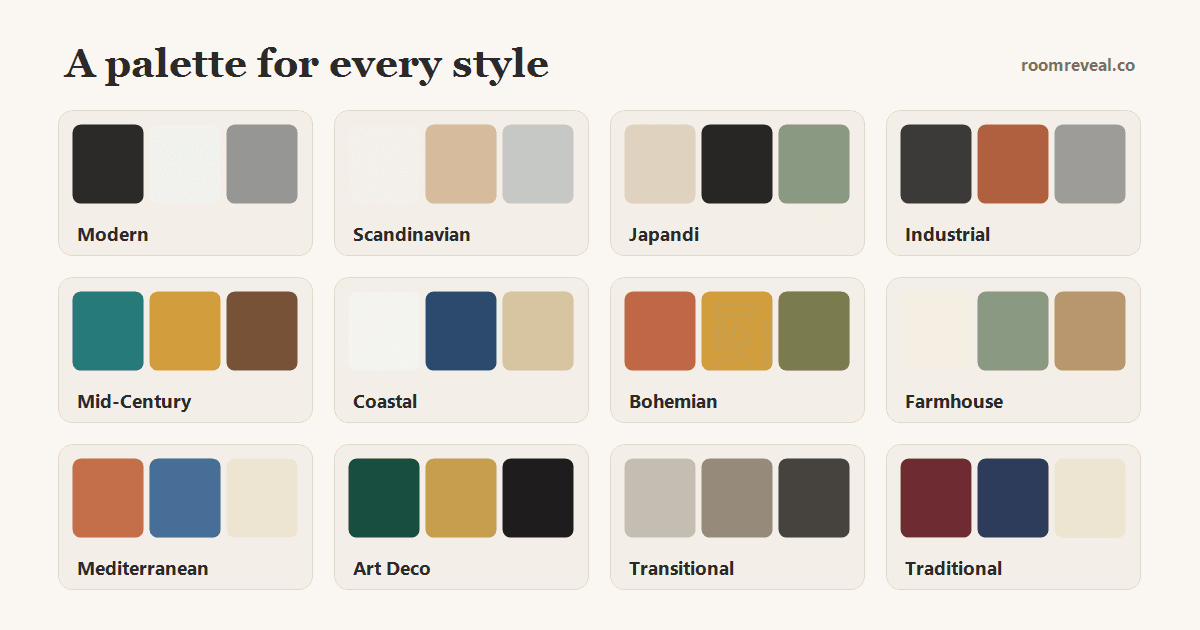
Japandi lives in warm, muted neutrals grounded by deeper earth tones. Think soft white, oatmeal, warm grey, and greige as the base; pale oak and natural linen for warmth; and charcoal, black, walnut, or terracotta as grounding accents. Muted, nature-derived greens and clay tones can add quiet color without breaking the calm. The rule of thumb: keep the palette low-contrast and earthy, then let one or two darker anchors give the room depth. Avoid bright, saturated color and cool blue-grays -- both pull the room away from Japandi's warmth.
How to Get the Look in Any Room
- Start by subtracting. Clear surfaces and remove anything that doesn't earn its place. Japandi is built on what you take away as much as what you add.
- Choose low, solid-wood furniture with clean lines. One beautifully made piece beats three forgettable ones.
- Build a two-tone wood story. Pair a light wood with a darker one so the room reads as Japandi, not just minimalist.
- Layer texture, not pattern. Linen, wool, rattan, and ceramic add warmth and depth while keeping the palette quiet.
- Keep the palette warm and muted -- soft neutrals with a couple of grounding dark or earthy accents.
- Edit your accessories hard. A few handmade, slightly imperfect objects say "Japandi"; a crowded shelf says the opposite.
- Maximize natural light and keep window treatments simple -- light linen or bare panes rather than heavy drapery.
Common Japandi Mistakes
The most frequent misstep is going cold: an all-white, hard-edged room with no warmth is minimalism, not Japandi -- it needs wood, texture, and softness. The second is clutter creep, where "just one more" accessory slowly erases the negative space that makes the style work. And the third is treating it as a shopping list of trendy objects rather than an exercise in restraint; Japandi is fundamentally about intention and "just enough," not about buying a specific set of things.
See It in Your Own Room
The fastest way to understand Japandi is to see it applied to a space you already know. Upload a photo of your room and preview it restyled with Room Reveal -- experiment with the two-tone woods and muted palette until the balance feels right. For room-specific inspiration, browse our Japandi living room ideas and Japandi bedroom ideas, or see how the style adapts to a workspace with Japandi home office ideas. And if you're still deciding between looks, our guide to 12 interior design styles puts Japandi in context alongside its neighbors.
Ready to transform your room?
Upload a photo and see it redesigned in any of our 12 styles.
Try Room RevealLooking for inspiration? Browse style-by-room ideas with tips, palettes, and looks to try in your own space.
Explore room ideas