How to Build a Mood Board That Actually Works
A mood board is the cheapest way to get a room right before you spend. Here's how to build one that holds together -- with a clear method for palette, materials, and proportion.
Room Reveal Team
June 24, 2026
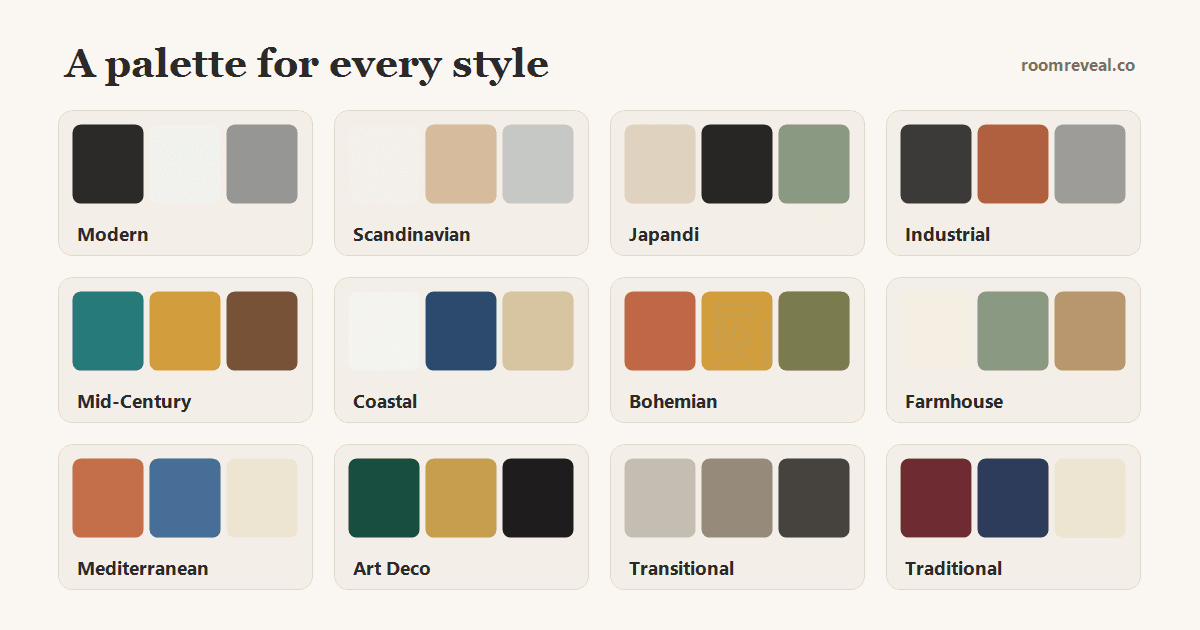
A mood board is the most underrated tool in decorating. Long before you buy a sofa or open a can of paint, it lets you make all the big decisions -- color, materials, mood, proportion -- on a single page where mistakes cost nothing. Get the board right and the room tends to follow. Skip it, and you end up buying piece by piece, hoping it all adds up to something coherent. It rarely does.
The catch is that most mood boards don't work. They're either a chaotic pile of every pretty image someone saved, or a tidy grid that looks lovely on screen and falls apart the moment it's translated into a real room. A board that works is a decision-making document, not a scrapbook. This guide walks through how to build one that genuinely predicts how your room will feel -- whether you're a homeowner planning one space or a designer trying to get a client to a confident yes.
What a Mood Board Is Actually For
A mood board has one job: to commit a direction to a single frame so you can judge it as a whole before you spend. It forces the decisions that "I'll figure it out as I shop" lets you dodge -- and it surfaces conflicts (a palette that fights your floor, two woods that clash) while they're still free to fix.
That reframing changes how you build it. You're not collecting things you like; you're assembling the specific things that will share one room and checking whether they belong together. Every element on the board should be something you could plausibly buy or do. A breathtaking image you'll never recreate is inspiration, not a board element -- keep those separate.
Step 1: Define the Brief Before You Pull a Single Image
The biggest reason boards drift into chaos is that they start with images instead of intent. Write down a short brief first, in plain language:
- The room and what it must do. "Primary bedroom, has to feel calm and also hide a lot of clutter." Function rules certain choices in and out before aesthetics ever enter.
- Three feeling words. Pick exactly three -- "warm, layered, grounded" or "bright, airy, simple." These become your filter: anything on the board that doesn't serve all three comes off.
- The fixed constraints. The floor you're keeping, the light the room gets, the sofa you can't replace. The board has to live with these, so they belong on it from the start.
- The budget reality. A board full of pieces you can't afford just designs a room you won't build. Aim it at what you'll actually spend.
Three feeling words and a list of constraints sounds almost too simple, but it's the difference between a board with a point of view and a pretty mess. Everything that follows gets measured against the brief.
Step 2: Lock the Palette First
Color is the backbone of a coherent room, so settle it before anything else. A reliable structure is a simple ratio: one dominant neutral for the large surfaces (walls, big upholstery), one or two secondary tones for medium elements (a rug, curtains, a second seat), and one accent reserved for the small, swappable layers (pillows, art, objects). Roughly 60% / 30% / 10%.
- Start from something fixed. Pull your palette out of a fixed feature -- the undertone of your floor, the stone in the kitchen, a rug you love. A palette anchored to a real element in the room is far more likely to actually work.
- Limit the count. Three to four colors total, including the neutral. More than that and a room reads busy no matter how nice each color is on its own.
- Mind the undertones. Put your colors side by side and check that the warms and cools agree. A "warm" board with one cold gray in it will feel subtly off in the room, even if you can't name why.
Step 3: Add Materials and Texture, Not Just Pictures
This is where weak boards fail. A board made only of catalog photos tells you what things look like but not how the room will feel, because a real room is a conversation between materials -- wood against linen against metal against stone. Represent those textures deliberately:
- Show the real surfaces. Include the wood tone, the metal finish, the fabric weave, the stone or tile. If you're working physically, real samples beat photos every time -- you can see how they catch light.
- Pick a metal and mostly commit. Choose a dominant metal finish (brass, black, nickel) so hardware, lighting, and legs feel intentional rather than accidental. One secondary metal as a deliberate accent is fine; three competing metals reads as unplanned.
- Limit your woods. Two wood tones that clearly differ (one light, one dark) look collected; three similar-but-slightly-off woods look like a mistake. Decide your woods on the board, not in the store.
- Balance hard and soft. A board heavy on hard, shiny surfaces will feel cold as a room; one with no contrast feels flat. Make sure linen, wool, and matte sit beside the glass and metal.
Step 4: Respect Proportion and Scale
Here's the trap that sinks the prettiest boards: a mood board has no sense of size. On a board, a giant sofa and a tiny side table take up whatever space you give them, so a collection that looks balanced on the page can be wildly out of scale in the room. Build proportion in deliberately:
- Size elements roughly to their real footprint. Make the sofa big and the accent objects small on the board, so the visual weight echoes the room's actual weight.
- Account for the big neutral surfaces. Walls and floor are most of what you'll see, but they barely show on a typical board. Give your dominant neutral the most space so the board honestly reflects the room.
- Check the "one hero" rule. A good room has one star and a supporting cast. If three things on your board are all shouting for attention, the room will feel chaotic -- demote two of them.
Step 5: Pressure-Test the Board Against the Brief
Before you act on a board, audit it. Read your three feeling words again and walk every element past them -- anything that doesn't serve all three comes off, however much you like it. Confirm the palette holds to three or four colors, the metals and woods are disciplined, and there's a clear hero. Then sit with it for a day; the piece that nags at you on second look is usually the one to cut. A board you've edited down is far more trustworthy than one you've only added to.
The Limit of Every Mood Board -- and How to Close It
Even a disciplined board has one unavoidable weakness: it's an abstraction. A neat grid of swatches and product shots still asks you to imagine how all of it wraps around your actual room, with your light, your proportions, and the things you're keeping. Imagination is a poor renderer, and this is exactly the gap where a board that looks perfect leads to a room that feels wrong -- the palette was right in the abstract but fights the floor, or the scale that balanced on the page overwhelms the space.
This is where digital visualization complements a mood board rather than replacing it. Once your board has settled the direction, you can take a photo of the room you actually have and see a credible, photo-realistic version of it in that palette and style -- the real walls, the real light, the furniture you're keeping. That turns the final check from an act of imagination into a reaction to a real image, and it's often where you catch the one thing the board couldn't show you. Use the board to decide the direction and the materials; use the preview to confirm it lands in your specific room before you buy. The honest framing: the preview is a planning and decision tool, not a substitute for measuring, sampling, and the judgment you bring to the board itself.
A Quick Mood-Board Checklist
- Write the brief first: the room's job, three feeling words, fixed constraints, real budget
- Lock a palette of three to four colors, anchored to something fixed, in a 60/30/10 ratio
- Include real materials and textures, not just product photos
- Commit to one dominant metal and at most two woods
- Size elements to their real footprint and give the neutrals their due space
- Choose one hero and demote the rest
- Edit against the brief, sleep on it, then cut what nags
- Preview the finished direction in your actual room before you spend
A mood board isn't busywork or a Pinterest hobby -- it's the cheapest, lowest-risk place to make every important decision about a room. Build it as a real document, edit it honestly against a clear brief, and it stops being a wish and becomes a plan you can buy from with confidence.
Need a starting point for the look you're after? Browse cohesive, palette-led inspiration like Japandi living room ideas or modern bedroom ideas -- both show how a tight palette, disciplined materials, and one clear hero hold a room together.
Once your board has set the direction, see it in your own space before you commit. Try Room Reveal to visualize your room in your chosen palette and style in seconds and confirm the look lands before you spend a thing.
Ready to transform your room?
Upload a photo and see it redesigned in any of our 12 styles.
Try Room RevealLooking for inspiration? Browse style-by-room ideas with tips, palettes, and looks to try in your own space.
Explore room ideas