Art Deco Style Explained: Origins, Hallmarks, and How to Get the Look
What is Art Deco interior design? A complete guide to its 1920s origins, the glamorous, geometric hallmarks that define it, a working palette, how Art Deco differs from Art Nouveau and Hollywood Regency, and how to get the look.
Room Reveal Team
June 26, 2026
Art Deco is the most unapologetically glamorous style in the design canon -- the look of jazz-age hotels, ocean liners, and skyline penthouses, built on bold geometry, rich materials, and a sense of optimistic luxury. Where most interior styles whisper, Art Deco performs: symmetrical sunbursts, lacquered surfaces, gleaming metal, and deep saturated color arranged with theatrical confidence. It is also a style that is easy to caricature, reduced to a gold fan motif and a velvet chair. Real Art Deco is a disciplined, architectural look with rules -- strong symmetry, repeating geometry, and a few opulent materials used decisively. This guide explains where Art Deco came from, the hallmarks that actually define it, the palette and materials that make it work, how it differs from Art Nouveau and Hollywood Regency, and how to get the look in any room.
What Is Art Deco Interior Design?
Art Deco emerged in the 1920s and 1930s, taking its name from the 1925 Paris Exposition Internationale des Arts Decoratifs. It was the design language of a confident, machine-age era -- a celebration of progress, speed, travel, and modern industry expressed through luxury. Unlike the handcrafted, nature-inspired movement that came before it, Art Deco embraced the streamlined, the symmetrical, and the manufactured: stepped skyscraper forms, sunbursts, chevrons, and sleek curves that echoed automobiles and airplanes.
In interiors, that translates to glamour with structure. An Art Deco room is built on strong symmetry and repeating geometric pattern, dressed in rich materials -- lacquer, polished metal, mirror, marble, and plush velvet -- and finished with bold, high-contrast color. The effect is deliberately luxurious and a little theatrical, but it is held together by order and proportion rather than clutter. Every glamorous element sits within a disciplined, architectural framework, which is exactly what keeps the opulence from tipping into excess.
The Hallmarks That Define Art Deco Style
1. Bold, repeating geometry
Geometry is the signature of the style. Sunburst and fan motifs, chevrons and zigzags, stepped forms, scallops, and concentric circles appear in everything from rugs and wallpaper to mirror frames and cabinet inlays. The patterns are crisp, graphic, and symmetrical -- repeated with intention to create rhythm and a sense of grand, ordered drama.
2. Strong symmetry and architectural lines
Art Deco rooms are arranged with deliberate balance: matched pairs of lamps, sconces, or chairs flanking a focal point, and furniture lined up to emphasize clean, confident lines. This symmetry is what gives the style its composed, almost monumental feel and keeps the rich materials from reading as chaos.
3. Luxurious, high-shine materials
Glamour comes from the surfaces. High-gloss lacquer, polished brass, chrome, and gold, mirrored panels, marble, and exotic-look veneers bring reflectivity and richness to the room. The interplay of matte and shine -- velvet against chrome, marble against lacquer -- is central to the look, catching light and signaling quiet opulence.
4. Plush, sculptural furniture
Furniture is curved, substantial, and upholstered for indulgence: rounded sofas, club chairs, channel-tufted velvet, and statement pieces with bold silhouettes. Forms are streamlined and sculptural rather than fussy, often with sleek metal or lacquered detailing that ties them to the geometric theme.
5. Rich, high-contrast color and statement decor
Deep, saturated colors -- emerald, sapphire, black, and oxblood -- paired with metallics and crisp contrast give Art Deco its dramatic punch. Decor is bold and curated: an oversized sunburst mirror, a sculptural lamp, a marble-topped bar cart, or a single graphic artwork, chosen to make a statement rather than fill space.
The Art Deco Palette
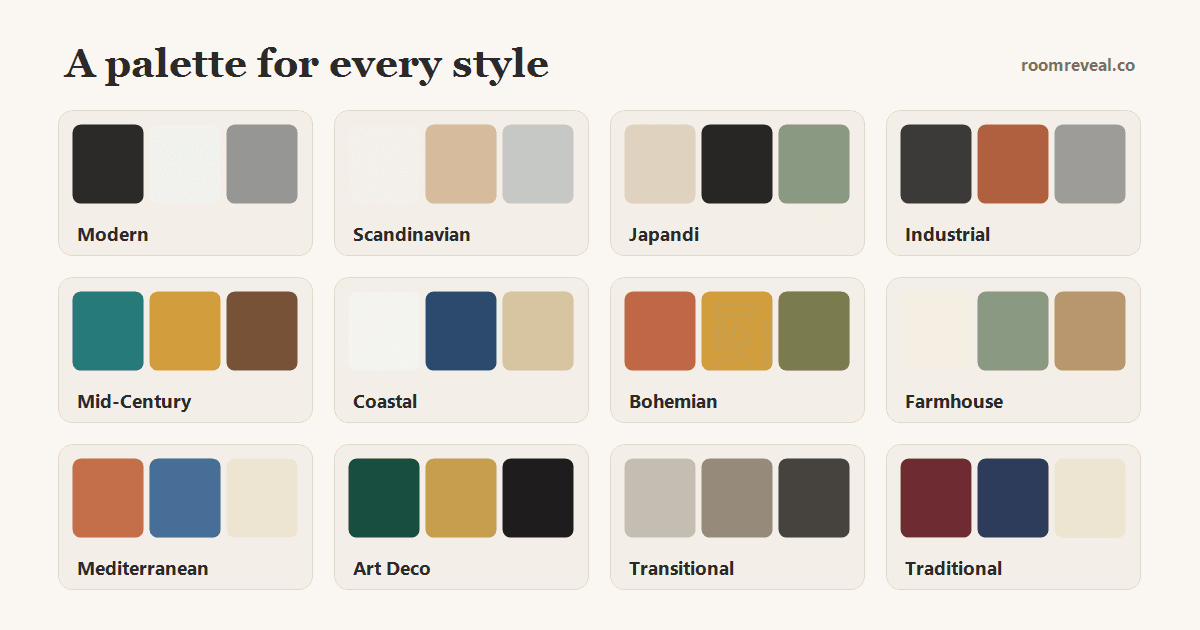
The Art Deco palette is built on drama and contrast. A grounding of black, charcoal, and crisp white or cream sets the stage, while jewel tones supply the richness -- emerald green, sapphire and royal blue, deep teal, ruby, and oxblood. Metallics are essential and act almost as a neutral: gold and brass for warmth, chrome and silver for a cooler, more streamlined version of the look. High contrast is the rule, so pairings are intentional and bold -- black with gold, emerald with brass, navy with cream -- rather than soft or blended. Softer, more residential Deco schemes swap some of the saturation for blush, dusty rose, soft greens, and warm taupe, still anchored by black and metallic accents. Because the materials carry so much shine and pattern, the color work is about decisive contrast and a few rich hues used confidently, not a wide spread of tones. Keep one or two jewel tones, a strong dark anchor, and a metallic running throughout, and the room reads glamorous and cohesive rather than busy.
Art Deco vs. Art Nouveau vs. Hollywood Regency
Art Deco is often confused with two neighbors, and the differences are worth knowing. Art Nouveau came just before it and is its near-opposite in spirit: where Art Nouveau is organic, flowing, and nature-inspired -- whiplash curves, vines, florals, and asymmetry drawn from the natural world -- Art Deco is geometric, symmetrical, and machine-inspired, trading curling botanicals for crisp chevrons and sunbursts. If the lines flow like plants, it is Nouveau; if they march in ordered geometry, it is Deco. Hollywood Regency, by contrast, is a later descendant rather than an opposite. It borrows Deco's glamour, symmetry, and metallics but turns up the color, the gloss, and the playfulness -- more lacquered brights, more high-shine, more maximalist sparkle, and fewer of the strict architectural geometric motifs. In short: Art Nouveau is organic and pre-Deco; Hollywood Regency is glossier, more colorful, and post-Deco. Art Deco sits between them as the disciplined, geometry-driven, jazz-age original.
How to Get the Look in Any Room
- Anchor with a dark, dramatic base. Use black, charcoal, navy, or a deep jewel tone on a wall, a sofa, or cabinetry to give the glamour something to play against.
- Add one strong geometric motif. Bring in a sunburst, chevron, or fan pattern through a rug, wallpaper, a mirror, or tile -- and let it repeat with intention.
- Mix metals and shine. Layer brass or gold with chrome, mirror, and lacquer so light bounces around the room; the matte-versus-shine contrast is the look.
- Arrange for symmetry. Flank a focal point with matched pairs -- lamps, sconces, or chairs -- to get the composed, architectural balance Deco depends on.
- Choose a few plush, sculptural pieces. A curved velvet sofa, a channel-tufted chair, or a marble-topped bar cart delivers the luxury without crowding the room.
- Edit hard. Pick a handful of statement pieces and give them space; Deco glamour reads as confidence, not clutter.
Common Art Deco Style Mistakes
The most common mistake is mistaking Art Deco for a theme and piling on gold fans, palm motifs, and "Gatsby" props until the room reads like a film set instead of a home. The fix is to lead with structure -- symmetry, a strong color anchor, and one disciplined geometric motif -- and let a few luxe materials do the rest. The second pitfall is all shine and no depth: chrome, mirror, and metallic everywhere with no matte velvet, marble, or dark anchor leaves a room cold and flat, so balance the gloss with rich texture and saturated color. The third is forgetting the architectural restraint at the heart of the style; Deco is bold but ordered, so without symmetry and editing the glamour tips into chaos. Keep the geometry crisp, the palette decisive, and the statement pieces few, and the look stays elegant rather than costumey.
See It in Your Own Room
The easiest way to judge whether Art Deco suits your space is to see it applied to a room you already know. Upload a photo and preview it restyled with Room Reveal -- test a dark anchor, a geometric motif, mixed metals, and a plush statement piece until the space feels glamorous and composed. For room-specific inspiration, browse our Art Deco living room ideas and Art Deco bedroom ideas, or see how the look elevates a workspace with Art Deco home office ideas. And if you're still weighing your options, our guide to 12 interior design styles places Art Deco design in context alongside its neighbors.
Ready to transform your room?
Upload a photo and see it redesigned in any of our 12 styles.
Try Room RevealLooking for inspiration? Browse style-by-room ideas with tips, palettes, and looks to try in your own space.
Explore room ideas